Publisher
EWTN Religious Catalogue
Published
June 17, 2026
ISBN
cp-the-great-adventure-catholic-bible---pap
Virtue scores
Review
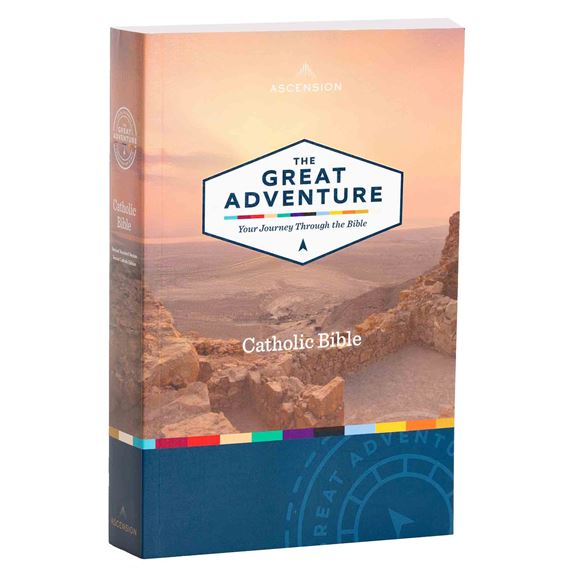
SECTION ONE Most Catholics own a Bible. Far fewer have read it. The Great Adventure Catholic Bible addresses that gap directly by doing something a standard edition does not: it organizes the entire canon around a narrative spine. Developed through the Great Adventure Bible study system originated by Jeff Cavins, the Bible uses a color-coded timeline to distinguish 14 narrative periods — from the Patriarchs through the Early Church — so that a reader opening Amos or Nehemiah knows immediately where they stand in the larger story of Israel and its God. The study notes, introductions, and cross-references are written for the parishioner who wants to read the whole Bible and has stopped at Leviticus every time. This is not a scholar's critical edition; it is a formation tool designed to make the Bible a book a Catholic can actually finish, and finish understanding. Parents preparing children for Confirmation, RCIA sponsors, small-group leaders, and adult Catholics who have never read beyond the Gospels are its natural audience. SECTION TWO - **Created**: Scripture testifies from its first verse to the dignity of the human person made in the image and likeness of God. By presenting the full canon as a coherent narrative rather than a collection of fragments, this Bible allows readers to encounter that testimony at full strength — the imago Dei is not just asserted in Genesis 1 but shown developing across covenants, psalms, prophecies, and epistles. The person reading this way begins to see their own existence as part of a story that began before them and will continue after them. - **Fallen**: The narrative structure makes the pattern of sin's disruption impossible to miss. The Exile period in Cavins' timeline is not just a historical fact; it is the shape of what Gaudium et Spes (n. 13) calls the dividedness within the human heart itself — the tendency to pursue goods in ways that fracture communion.[^2] Reading Israel's repeated cycles of fidelity, infidelity, and return trains the reader to recognize the same pattern operating in their own life without the text needing to say so explicitly. - **Redeemed**: The color-coding culminates in the New Testament period labeled 'The Church,' which presents the early Christian community as the living continuation of Israel's story, not its replacement. This structurally communicates what the Aparecida document describes as 'new life' — the conviction that belonging to the People of God is not a private spiritual transaction but an entry into a community with a history, a mission, and a destination.[^1] The Bible as physical object becomes an icon of that ongoing story. - **Prudence (docility / teachability)**: The study notes position the reader explicitly as someone learning to read within the Church's tradition. Introductions frame each book with the question of how the ancient text addresses the reader now, modeling the intellectual humility that Aquinas identifies as an integral part of prudence — the capacity to receive instruction rather than insist on private judgment. - **Justice (worship / prayer)**: By presenting the Psalms within the narrative context of Israel's liturgical life, the Bible trains the reader to understand prayer as participation in a covenant relationship rather than personal therapeutic expression. The Psalms are not mood-matched poetry; they are the Church's speech to God across millennia, and this edition's structure makes that clear. SECTION THREE The Aparecida document's sustained attention to 'new life,' 'pastoral conversion,' and the formation of 'Peoples' within the Church's missionary identity provides the closest conversation partner in the retrieved corpus:[^1] both the Aparecida document and this Bible share the conviction that personal encounter with Scripture is inseparable from belonging to a community on mission. Paul VI's Ecclesiam Suam, with its citation of Matthew 28:19 ('Go therefore and teach all nations') and Matthew 13:52 ('every scribe trained for the kingdom of heaven'), frames the Church's dialogue with the world as rooted in a scripturally formed people,[^3] which is precisely what this Bible is designed to produce. John Paul II's Dominum et Vivificantem, drawing on Romans 7:14-15, reminds us that the human heart reading Scripture is not a neutral reader but a divided one — the very brokenness the biblical narrative maps is the brokenness the reader brings to the page.[^2] ## References [^1]: CELAM. (2007). *Aparecida: Document of the Fifth General Conference of the Bishops of Latin America and the Caribbean*. CELAM. Index entries: New life, Pastoral conversion, Peoples of God. [^2]: John Paul II. (1986). *Dominum et Vivificantem* [Encyclical on the Holy Spirit in the life of the Church and the world]. Vatican. Cf. Rom 7:14-15, 19; Gaudium et Spes, n. 13. [^3]: Paul VI. (1964). *Ecclesiam Suam* [Encyclical on the paths of the Church]. Vatican. Cf. Mt 28:19; Mt 13:52.
✓ Strengths
- ✓Structures the entire biblical narrative as a unified story of creation, fall, and redemption — the Great Adventure color-coded timeline gives readers a framework for seeing Scripture's arc rather than experiencing it as disconnected texts.
- ✓The study notes are written for ordinary Catholics who have never read the Bible systematically, making the full canon accessible without requiring seminary-level background, which directly addresses the widespread biblical illiteracy documented among practicing Catholics.
- ✓By presenting Scripture in its canonical order alongside thematic cross-references, the Bible trains the reader's memory (prudence-memory) to hold the whole story of salvation while reading any individual passage.
- ✓The devotional apparatus — introductions, call-outs, and summaries developed by Jeff Cavins and the Ascension Press team — models the virtue of docility (prudence-teachability), positioning the reader as a learner under the Church's interpretive tradition rather than a lone interpreter.
- ✓Its publication through EWTN Religious Catalogue places it within an explicitly Catholic magisterial context, signaling that the interpretation offered remains accountable to the Church's reading of Scripture.
⚠ Considerations
- ⚠Color-coded narrative Bibles can inadvertently train readers to treat the 'story threads' as the whole of Scripture, potentially de-emphasizing the Wisdom literature, the Psalms as prayer, and the prophetic books as more than narrative scaffolding — formators should supplement with lectio divina practice.
- ⚠Though more financially accessible, paperback editions are notably less durable than their hardcover/leather bound alternatives.