JERUSALEM BIBLE WITH TAPESTRY BIBLE COVER SPECIAL
Publisher
EWTN Religious Catalogue
Published
June 17, 2026
ISBN
cp-jerusalem-bible-with-tapestry-bible-cove
Virtue scores
Review
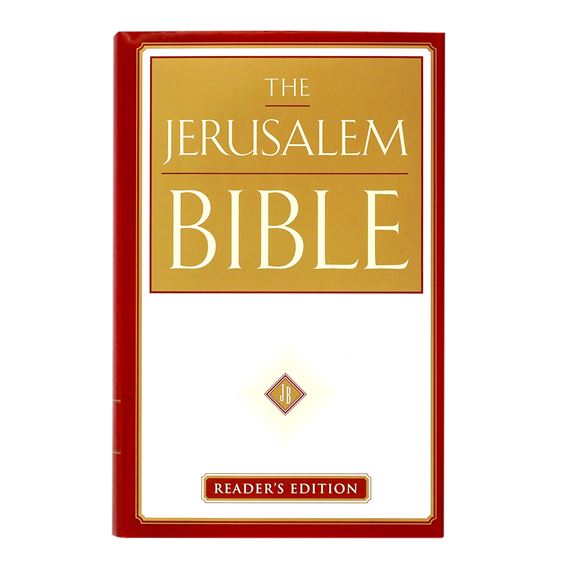
SECTION ONE The Jerusalem Bible, first published in English in 1966 from the French translation produced at the Ecole Biblique et Archeologique Francaise in Jerusalem, remains one of the landmark Catholic vernacular translations of the modern era. Where many biblical editions aim primarily at doctrinal precision or liturgical utility, the Jerusalem Bible pursued a third goal alongside both: literary life. Its translators — working from the original Hebrew, Aramaic, and Greek — sought prose and verse that could be read aloud without wincing, that preserved the emotional register of the original texts, and that would hold up over decades of private prayer. The Tapestry Bible cover edition offered through the EWTN Religious Catalogue is a presentation version of this text, designed for gift-giving and long-term use. The audience is broad: anyone entering or deepening Catholic faith, households building a library of formation materials, parishes equipping RCIA candidates, or individuals seeking a Bible whose physical form matches the gravity of what it contains. SECTION TWO - **Created**: The Jerusalem Bible's Psalter presses directly on what Vitz, Nordling, and Titus describe as the created person's capacity for right worship — the imago Dei expressed through praise, lament, and petition addressed to the source of all being. The Psalms do not merely describe God; they train the person's affective life to move toward God in the full range of human experience, from desolation to exultation, treating the reader as someone whose emotions are not obstacles to prayer but its very material. - **Fallen**: The Old Testament wisdom literature and the prophetic books, rendered in the Jerusalem Bible with unusual directness, name the disorder of sin without euphemism. Concupiscence, idolatry, and the human tendency to substitute created goods for the Creator are named structurally across the canon — not as isolated moral failures but as patterns woven through Israel's history and, by implication, through every human life. - **Redeemed**: The New Testament in the Jerusalem Bible presents the Paschal Mystery as the axis of history. The Resurrection accounts, Paul's letters on grace, and the Book of Revelation's vision of the New Jerusalem are all positioned within a narrative of restoration that is not cyclical repetition but genuine forward movement toward a fulfilled end. The person is not trapped in the past but moving, in faith, toward a completion that grace has already secured. - **Justice (prayer and adoration)**: The physical form of this edition — a Tapestry cover designed for durability and gift use — reinforces that prayer is a bodily as well as interior act. Handling a well-made Bible daily, marking it, returning to it, is itself a formation in the virtue of devotion as Aquinas understood it: the will promptly directed to divine service through habitual practice. - **Prudence (memory)**: The Jerusalem Bible's introductory notes and cross-references (standard in full editions) train the integral virtue of memory as it applies to Scripture: learning to read a passage in light of the whole canon, retaining the shape of salvation history so that each individual text speaks within its proper context rather than in isolation. ## References [^1]: Ratzinger, J. (2004). *Introduction to Christianity* (J. R. Foster & M. J. Miller, Trans.). Ignatius Press. p. 254. [^2]: Benedict XVI. (n.d.). *Wednesday Audiences* [Papal audience transcripts]. Vatican Publishing House. p. 1. [^3]: Augustine of Hippo. (2012). *The Confessions* (F. J. Sheed, Trans.). Sheed & Ward. [Psalm citation index, pp. 419ff.].
✓ Strengths
- ✓The Jerusalem Bible is one of the most respected Catholic vernacular translations of the 20th century, produced by the Dominican scholars of the Ecole Biblique in Jerusalem and distinguished by its literary quality alongside rigorous textual scholarship — making it accessible for both liturgical prayer and private study.
- ✓Scripture is the privileged locus of encounter between the human person and divine Revelation; this edition, formatted for Catholic use and sold through EWTN, situates the reader within the worshipping Church rather than as a solo academic reader.
- ✓The Psalter within the Jerusalem Bible has a particular reputation for poetic force, which supports the virtue of prayer and adoration: praying the Psalms trains the affective dimension of the person to move toward God with the full range of human emotion, from lament to praise.
- ✓As an EWTN Religious Catalogue item, this edition is positioned for formation contexts — parish gifting, RCIA, sacramental preparation — where docility to Scripture and the Church's interpretive tradition (prudence-teachability) is directly exercised.
⚠ Considerations
- ⚠The Jerusalem Bible translation, while celebrated for its literary quality, uses certain dynamic-equivalence choices (particularly in the New Testament) that some Catholic scholars prefer to supplement with the Revised Standard Version Catholic Edition for doctrinal precision; users in theological formation settings should be aware of this.