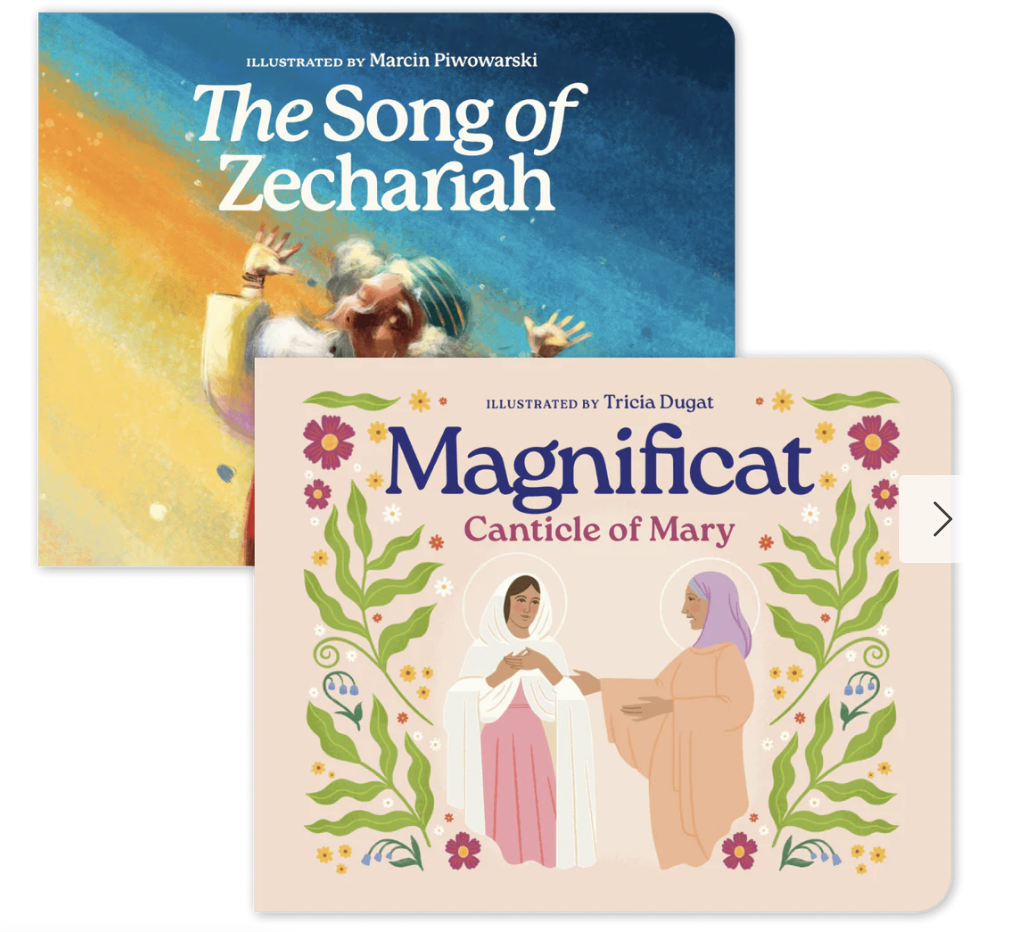
The Song of Zechariah and Magnificat Bundle
Virtue scores
Review
SECTION ONE Two of the most compressed theological poems in the New Testament appear within four verses of each other in Luke 1, and most Christians have heard them sung without pausing over what they actually argue. Zechariah, struck mute for doubting Gabriel, opens his mouth at his son's naming and immediately recites a century-by-century covenant history, locating this newborn in the line of Abraham and David before naming him prophet of the Most High. Mary, visiting her cousin Elizabeth, sings of a God who already acts in the past tense — 'he has scattered,' 'he has put down,' 'he has exalted' — as if the Incarnation has already reordered the world. Word on Fire's bundle of these two canticles, the Benedictus and the Magnificat, gathers texts that the Church has prayed at Morning Prayer and Evening Prayer respectively every day for over a millennium. SECTION TWO - **Created**: The Magnificat grounds human dignity not in what Mary has achieved but in what God sees — 'he has looked upon the lowliness of his handmaid.' The imago Dei here is not a philosophical premise but a narrative event: the Creator's gaze constitutes the creature's worth. This is as specific an affirmation of original goodness as the New Testament offers. - **Fallen**: Both canticles presuppose a world badly disordered. Zechariah prays for deliverance 'from the hand of our enemies,' and Mary names pride, power, and hoarding as the conditions God reverses. The Fallen state is not abstracted into generic sinfulness but named in its social and interior forms: the proud in the conceit of their hearts, the mighty on their thrones. - **Redeemed**: The Benedictus describes redemption through the specific mechanism of covenant memory — God 'has raised up a horn of salvation in the house of David his servant, as he spoke by the mouth of his holy prophets from of old.' Salvation is not a surprise intervention but the completion of a promise made to Abraham. The Redeemed state, in Zechariah's telling, is the Created state arriving at its intended end. - **Justice (adoration and gratitude)**: Both canticles are formal acts of the virtue Aquinas calls latria — the worship owed to God alone. They train the reader not merely to feel grateful but to articulate the precise grounds of praise, which is the difference between sentiment and the stable habit of adoration. - **Prudence (memory)**: The Benedictus is a sustained exercise in what Aquinas identifies as memory's integral role within prudence: Zechariah moves from remembered covenant acts to present circumstances to future mission, modeling the movement from past experience to sound present judgment that Aquinas regards as constitutive of practical wisdom. SECTION THREE A recorded Morning Prayer service pairs the Benedictus directly with Romans 12 — Paul's call for transformation through the renewal of the mind [^1] — and the juxtaposition is theologically exact: Zechariah's recitation of covenant history is itself the kind of mind-renewal Paul prescribes, replacing disordered self-reference with a remembered account of God's acts. A second liturgical recording situates the Benedictus within a service organized around covenant fidelity and messianic promise [^2], showing how the canticle functions not as a private devotion but as the Church's corporate act of locating herself within salvation history. The Magnificat appears in a midday prayer context that pairs it explicitly with themes of divine mercy and the Incarnation [^3], a pairing that confirms what Mary's song already implies: the reversal of worldly hierarchies is not a political program but the anthropological consequence of the Word taking flesh in the womb of someone the world considered without status. Read together, these three liturgical contexts from the canon suggest that the bundle's deepest purpose is to give the reader a place to stand — inside the Church's daily prayer — from which the whole of Christian anthropology becomes legible. ## References 1. DMU video lecture (n.d.). *Liturgical service — Epistle Reading and Benedictus Canticle with Spiritual Transformation*. Segment 4 (00:08:05-00:11:21). — 'Romans 12 calling for spiritual transformation through the renewal of the mind and self-offering as a living sacrifice' 2. DMU video lecture (n.d.). *Liturgical service — Benedictus and Messianic Promise*. Segment 4 (00:10:09-00:13:31). — 'God's covenant fidelity, redemption of Israel through a mighty Savior born of David's line, and prophetic fulfillment' 3. DMU video lecture (n.d.). *Liturgical service — The Magnificat canticle*. Segment 2 (00:01:08-00:04:29). — 'proclaiming Mary's joy in God as Savior, celebrating God's mercy toward the humble, and His reversal of worldly hierarchies'
✓ Strengths
- ✓The Benedictus and Magnificat are among Scripture's most theologically concentrated speech-acts: Zechariah proclaims God's fulfillment of covenantal promises across centuries of waiting, and Mary names the specific mechanism of divine reversal — the lowly raised, the proud scattered — grounding human dignity not in social status but in God's elective mercy.
- ✓Both canticles hold the Created and Redeemed states in direct tension, showing that God's saving act is not an afterthought to creation but the completion of what was always intended for Israel and, by extension, for every person formed in the imago Dei.
- ✓The Magnificat trains the virtue of gratitude (justice-gratitude) at a structural level: Mary does not merely feel thankful but articulates the specific grounds of praise — God looked upon her lowliness — modeling the Thomistic account of gratitude as a reasoned acknowledgment of a received gift.
- ✓The Benedictus exercises prudence-memory explicitly: Zechariah recites the Abraham covenant, the Davidic promise, and the prophets as a cumulative record that makes the present birth intelligible, showing how memory of God's acts is itself a form of practical wisdom.
- ✓Published by Word on Fire, the bundle situates these ancient texts within a contemporary catechetical context, making the Church's daily prayer — the Liturgy of the Hours — accessible to readers who may have encountered these canticles only at Mass without grasping their full covenantal architecture.