Catholicism: A Journey to the Heart of the Faith (Second Edition)
by Bishop Robert Barron
Virtue scores
Review
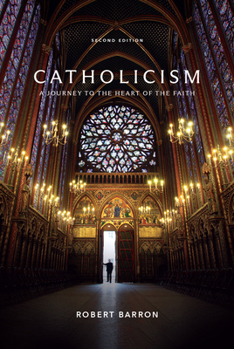
SECTION ONE Robert Barron's Catholicism: A Journey to the Heart of the Faith began as the companion volume to his ten-part documentary series of the same name, and it reads like a guided tour taken by someone who has spent decades thinking about how to explain two thousand years of theological and artistic inheritance to a person encountering it for the first time. The book moves through the person of Jesus Christ, the nature of the Church, the sacraments, Mary, the saints, and the final destiny of the human being -- not as a catechism checklist but as a coherent argument: that Catholicism is not a set of rules imposed on human experience but a vision of reality that makes better sense of human experience than any rival account. Barron is a skilled popularizer in the best sense of that term -- he draws on Aquinas, Augustine, Chesterton, and the great tradition of Catholic art and architecture to show that the faith is intellectually serious and aesthetically serious, that beauty and truth hold together. The intended audience is anyone curious about what Catholicism actually claims: skeptics, returning Catholics, inquirers, and lifelong believers who want a map of the whole. Word on Fire published the second edition with updated photography and revised text; the visual dimension matters, because Barron's argument is partly that the cathedrals, the icons, and the liturgy are not decoration but carriers of theological content. SECTION TWO - **Created**: Barron grounds his entire presentation in the claim that the human person is not an accident but a being made for communion with God -- a claim he does not treat as pious decoration but as the structural premise of every chapter. His reading of the Incarnation insists on the goodness of matter itself: that God took on a body means bodies matter, and that Catholic sacramental practice (water, oil, bread, wine) flows directly from this conviction about created reality. The imago Dei is not an abstraction here but the reason the Church has historically built libraries, hospitals, and universities. - **Fallen**: Barron does not skip the problem of sin, and his treatment of evil -- drawing particularly on Aquinas's account of sin as privation, a twisting of something originally good -- gives readers a way to think about moral disorder that avoids both sentimentalism and despair. He presents the Cross not as God's punishment of an arbitrarily defined infraction but as God's response to the real weight of human violence, self-deception, and the refusal of love. This is one of the book's stronger moves: the Fallen condition is shown as something that required a specific, costly response, not a policy adjustment. - **Redeemed**: The sacramental theology at the center of the book is where the Redeemed dimension operates most concretely. Barron presents the Eucharist not as a memorial rite but as participation in Christ's own life -- a claim rooted in the patristic and Thomistic tradition of grace as real transformation of the person, not merely external forgiveness. The saints function throughout the book as evidence that this transformation actually occurs in historically verifiable lives. - **Justice (adoration and worship)**: By treating the Mass as the summit and source of Christian life -- a formulation from Sacrosanctum Concilium that Barron develops at length -- the book makes the case that the virtue of religion, the giving of proper worship to God, is not a peripheral practice but the form that orients all other virtues. The liturgical chapters show worship as the act that most fully expresses what the human person is for. - **Prudence (teachability)**: Barron consistently models docility as an intellectual virtue. He presents himself throughout as someone formed by a tradition he did not invent, and he invites readers into the same posture -- learning from Augustine on restlessness, from Aquinas on the intellect's natural desire for God, from John of the Cross on the dark night. The reader who finishes the book has been taught how to read Catholic tradition, not merely what it concludes. SECTION THREE Barron's account of the human person as made for communion sits in close alignment with the interpersonal-relationality chapter in Vitz, Nordling, and Titus[^1], where the CCMMP insists that the person is constitutively relational and that psychological health cannot be separated from right relationship with God, self, and neighbor -- the same triad that Barron organizes his entire survey around. The pneumatological background of Barron's treatment of conscience and the interior life resonates with John Paul II's[^2] reading in Dominum et Vivificantem of Gaudium et Spes 16, which describes conscience as the place where the human person is alone with God -- a depth that, as the text notes, Augustine already named as an abyss no other human being can fully read. Where Barron's book is primarily synthetic and introductory, Pope Francis's Dilexit Nos[^3] -- drawing on Gaudium et Spes 10 -- presses further into what happens when the heart's deepest question meets the Sacred Heart of Christ, offering a more contemplative register that would complement Barron's more catechetical one for readers ready to go deeper. ## References 1. Vitz, P. C., Nordling, W. J., & Titus, C. S. (2020). *A Catholic Christian Meta-Model of the Person*. Chapter: 'Interpersonally relational' (pp. 306-330). Divine Mercy University Press. 2. John Paul II (1986). *Dominum et Vivificantem*. Citing Gaudium et Spes, n. 16 — 'conscience as the place where the human person is alone with God.' 3. Pope Francis (2024). *Dilexit Nos*. Citing Gaudium et Spes, n. 10 — 'the question the human heart cannot answer by itself.'
✓ Strengths
- ✓Barron situates Catholic faith within an integrated vision of the person -- body, soul, intellect, and will -- treating doctrine, liturgy, and moral life as a unified whole rather than separable compartments, which directly serves readers seeking a coherent account of Christian identity.
- ✓The book addresses the Fallen condition honestly: Barron does not minimize sin or present Catholicism as self-improvement therapy, but instead shows how the sacramental system and the Eucharist specifically exist because human beings cannot restore themselves by will alone.
- ✓The Redeemed dimension is treated with theological precision through attention to grace as participation in divine life -- not merely moral reformation -- drawing on the tradition from Aquinas through Vatican II.
- ✓Barron's treatment of the saints as concrete instantiations of virtue gives abstract moral teaching a human face, making the book practically formative rather than only intellectually informative.
- ✓The book trains the virtue of docility (prudence-teachability) by walking readers through two millennia of Church teaching as a living inheritance rather than an archive, modeling the posture of learning from those who came before.
⚠ Considerations
- ⚠Because the book is structured as a broad introductory survey, readers already familiar with Aquinas or the patristic sources may find the anthropological foundations -- particularly on the passions and concupiscence -- treated more lightly than the topic warrants for clinical or formation contexts.
- ⚠The book's accessibility-first design means that the Fallen dimension, while acknowledged, receives less sustained attention than the Created and Redeemed states; readers in serious moral or psychological distress may need supplementary resources alongside it.