Virtue scores
Review
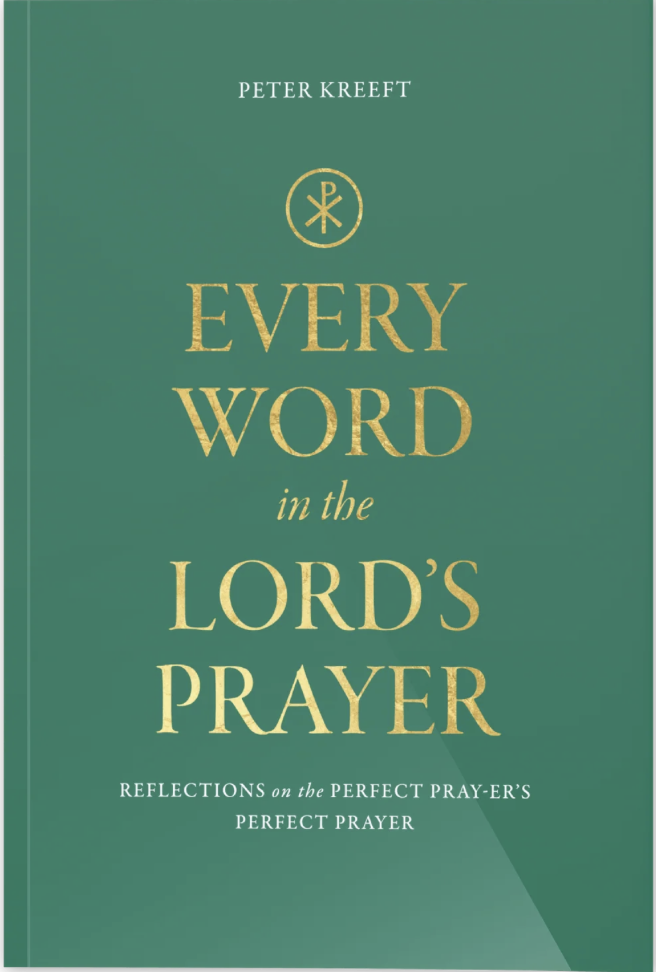
SECTION ONE Some books about the Lord's Prayer survey its theology. This one slows down enough to ask what each individual word is doing. Published by Word on Fire, Every Word in the Lord's Prayer moves through the prayer phrase by phrase — 'Our,' 'Father,' 'who art in heaven,' 'hallowed,' 'thy name' — treating each term as a doorway rather than a stepping stone. The audience is any Catholic Christian who has ever said the Pater Noster on autopilot and wondered whether familiarity had worn the words smooth. The book's wager is that the prayer Jesus taught contains, compressed into a few dozen words, everything a human being needs to know about who God is, who we are in relation to him, and what we should want. Readers who work through it slowly will find themselves rereading a prayer they thought they already knew. SECTION TWO - **Created**: The book's attention to 'Our Father' affirms the imago Dei at the level of grammar. To address God as Father is to accept a given identity — creature, child, member of a family not of our own making. This is not a projection of human fatherhood onto God but a reception of a name God first spoke, which grounds human dignity in something prior to achievement or merit. - **Fallen**: The petition 'forgive us our trespasses as we forgive those who trespass against us' confronts the reader with the asymmetry between what we ask and what we give. Concupiscence, in Aquinas's account, is not only disordered appetite for pleasure but a disordered orientation of the will away from others — and this phrase of the prayer names that disorder precisely, linking reception of mercy to its extension. - **Redeemed**: The final petitions — 'deliver us from evil' — place the person inside a drama of rescue rather than self-improvement. Grace arrives as liberation, not merely as moral assistance. This frames the redeemed state not as a plateau the will climbs to but as something the person is drawn into by the one who already overcame the evil in question. - **Justice (prayer)**: By treating each word as worthy of sustained attention, the book forms in the reader the specific act that Aquinas places under justice: rendering to God what is owed. Prayer is not self-expression but a debt of worship, and the word-by-word format enacts exactly the deliberate, attentive rendering that the virtue requires. - **Prudence (docility)**: The format assumes that the reader does not yet understand the prayer, even after years of saying it. This is docility in the classical sense — openness to being taught by a text that precedes and exceeds the reader — and the book's structure makes it structurally impossible to skip past a word the reader thinks they already grasp. SECTION THREE Pope Benedict XVI[^1], in his Wednesday Audiences, argues that authentic prayer requires the person to enter into the 'we' of the Church — transforming the solitary 'I' by immersing it in words the community has prayed across centuries. Every Word in the Lord's Prayer operates on the same principle: the reader is not composing original prayer but receiving one, word by word, from a tradition that predates them. Pérez de Urbel[^2], in his Vida de Cristo, observes that in the Lord's Prayer 'there is not one word too many' — that its brevity and its inexhaustibility are the same quality, not a tension — which the word-by-word format vindicates by demonstration rather than assertion. Bonhoeffer[^3], writing from a Protestant standpoint in The Cost of Discipleship, insists that the Lord's Prayer is 'the way Christians must pray,' not merely a pattern — a claim this book implicitly extends by showing that praying it well requires inhabiting each of its words rather than moving through them. John Paul II's Dominum et Vivificantem[^4] adds a pneumatological dimension that the book would benefit from making explicit: the Spirit 'guides us from within in prayer,' which means the slow, attentive posture the book cultivates is itself a form of openness to the Spirit's intercession. ## References 1. Pope Benedict XVI (n.d.). *Wednesday Audiences*. — 'I learn to pray, I nourish my prayer by addressing God as Father and praying-with-others, praying with the Church.' 2. Fray Justo Pérez de Urbel (n.d.). *Vida de Cristo*. — 'es difícil encontrar palabras que, en medio de tanta sencillez, encierren tanta grandeza y fecundidad.' 3. Dietrich Bonhoeffer (n.d.). *The Cost of Discipleship*. — 'The Lord's Prayer is not merely the pattern prayer, it is the way Christians must pray.' 4. John Paul II (n.d.). *Dominum et Vivificantem*. — 'the Holy Spirit not only enables us to pray, but guides us from within in prayer: he is present in our prayer.'
✓ Strengths
- ✓The book treats the Lord's Prayer not as a formula to be recited but as a grammar of the soul — each petition mapping a specific orientation of the person toward God, which gives the reader a structured anthropology of desire.
- ✓By attending to each individual word rather than each petition as a whole, the book trains a habit of contemplative attention that belongs to the virtue of devotion — the interior readiness that precedes all ordered worship.
- ✓The opening address 'Our Father' receives treatment that addresses the communal dimension of prayer, refusing any merely private or individualist spirituality and placing the reader inside the Church's corporate cry.
- ✓The petition for daily bread locates the body, not just the soul, within the act of prayer, implicitly affirming the unity of the human person and resisting any Gnostic drift away from material creaturely dependence.
- ✓The section on forgiveness — 'as we forgive those who trespass against us' — shows the reader that petition and moral formation are inseparable: what we ask of God, we must begin to enact toward others.
⚠ Considerations
- ⚠The word-by-word format, while spiritually generative, risks fragmenting the prayer's chiastic structure — in which the first three petitions mirror the last three around the daily-bread pivot — if each word is isolated without synthesis.