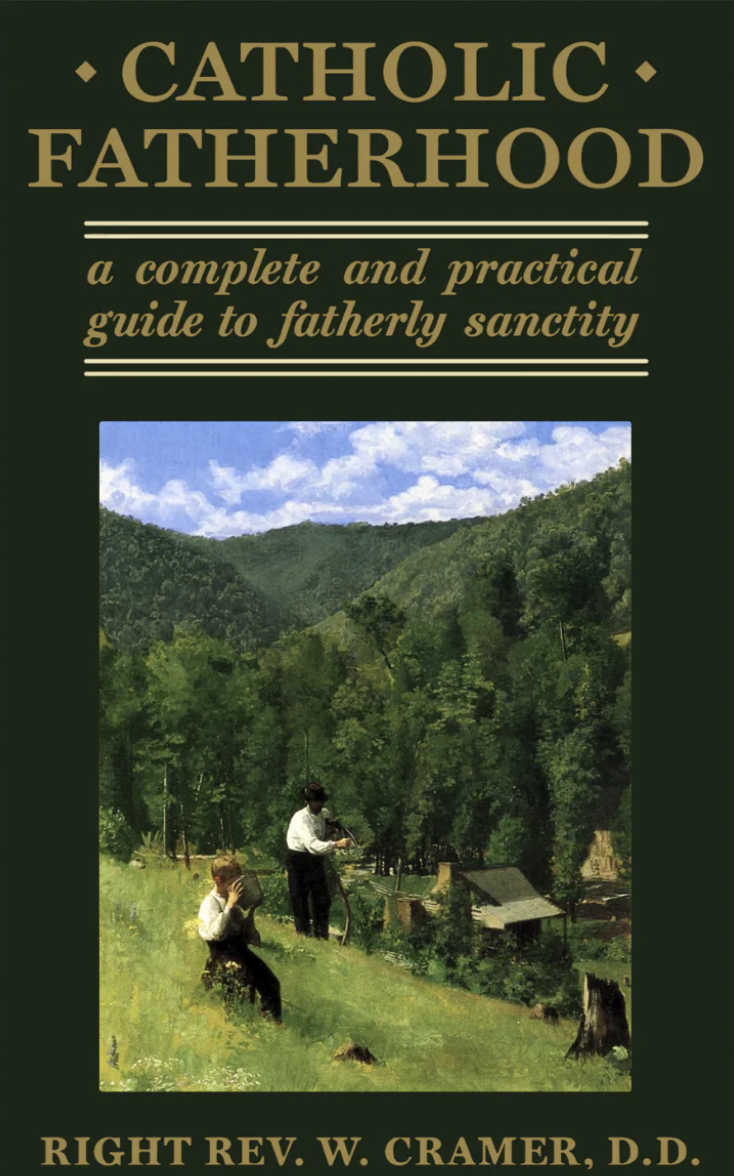
Catholic Fatherhood: A Complete and Practical Guide to Fatherly Sanctity
by Right Rev. Wilhelm Cramer
Virtue scores
Review
From Cor Jesu Press comes this retitled edition of The Christian Father: What He Should Be, and What He Should Do Before the first chapter opens, Bishop W. Cramer of Münster lays down what will become the governing logic of the entire book: the human father is not merely a provider, disciplinarian, or head of household. He is, in the strict theological sense, an image and representative of God the Father on earth. "All paternity in heaven and on earth is from God," Cramer writes, citing St. Paul — and from this single conviction, the rest of the work flows with remarkable coherence. The Christian Father, first published in 1883 and translated into English by Rev. L.A. Lambert for an American Catholic readership, is a slender but serious guide addressed directly to Catholic men. Its structure is simple: Part I makes the theological and moral case for what a Christian father must be; Part II collects prayers for fathers covering everything from morning and evening devotion to petitions for children's purity, protection from temptation, and faithful choosing of a state in life. What makes the first section compelling is Cramer's insistence that the father's spiritual condition is not incidental to his children's formation — it is constitutive of it. A father who neglects prayer, avoids the sacraments, or lives carelessly is not simply failing himself; he is actively shaping his children toward the same failure. "Example draws," Cramer repeats. If the father does not pray, the children will not pray. If he leaves at the sermon, his son follows him down the aisle. The logic is unavoidable: a father cannot transmit what he does not possess. This places an unusual weight on the father's own conversion and ongoing interior life. Cramer devotes several pages to a candid examination of conscience addressed directly to the reader — a father reviewing a sinful past, compromised faith, disordered habits. The tone is neither scolding nor despairing. Rather, it is pastorally urgent: "Whatever your past life may have been, now at least will earnestly, will to become a good Christian father." His repentance is not only his own salvation; it is his children's deliverance. Cramer is equally clear that the father's role is irreplaceable even when the mother is exemplary. A devout mother working alone cannot complete the work God intends for two. The father and mother together form, in Cramer's phrasing, "a complete whole" — the masculine qualities of reason, will, and authority complementing the feminine qualities of tenderness and devotion. Neither alone produces the full picture. The absence of either is a genuine wound. The practical sections cover governance (law, rule, and order in the home), the supervision of children both inside and outside the household, the dangers of tavern-going and bad literature, keeping holy the Sabbath, and the father's responsibility in guiding children toward their vocation. Two biblical models receive extended treatment — Abraham and Tobias — as exemplars of paternal faith under trial. The collection of prayers in Part II is the book's quietly remarkable second half. These are not generic devotions. They are specific to a father's state: prayers for his own faith, for temperance, for wisdom in governing, for the protection of children at risk, for a son or daughter entering the world. They assume a father who understands his role before God and takes it seriously enough to bring it explicitly to prayer. The Christian Father is a nineteenth-century text, and it reads like one — earnest, direct, rhetorically formal. But its core argument has not aged: that the family is the primary cell of the Church, that the father's own Christian life is the indispensable foundation of his children's formation, and that fatherhood rightly understood is one of the most demanding and most glorious vocations God has given to men. Sources The Christian Father (full PDF) Catholic Family Library, Benziger Brothers, New York — 25th thousand printing, copyright 1883
✓ Strengths
- ✓Treats fatherhood as a vocation ordered toward sanctity rather than a social role, giving the book a theological seriousness largely absent from contemporary parenting literature.
- ✓Integrates ascetical practice — temperance, ordered prayer, household governance — into a single coherent vision of paternal life, rather than treating these as separable self-improvement projects.
- ✓The inclusion of prayers composed specifically for a father interceding for wife and children makes the book a practical devotional tool, not only a theoretical guide.
- ✓Written in 1883, Cramer's counsel predates the therapeutic reduction of fatherhood to emotional availability alone, and so offers a complementary account of authority, order, and moral leadership that contemporary sources rarely supply.
- ✓Addresses vocation guidance for children as a specific paternal duty, connecting the father's discernment to the long-range formation of the household rather than only to immediate discipline.
- ✓Complementary, not dismissive, of the mother's role
⚠ Considerations
- ⚠The nineteenth-century context means some pastoral framing around household authority may require careful reading against the more relational and egalitarian anthropology developed by John Paul II in 'Love and Responsibility' and 'Theology of the Body,' which grounds spousal authority in mutual self-gift rather than hierarchical order alone.
- ⚠The press description offers no indication of how Cramer handles the father's interior life or his own spiritual poverty; a purely outward-facing asceticism risks neglecting the Fallen-state realism that grounds authentic paternal humility.
- ⚠At 171 pages with an unknown original publisher and no critical apparatus, readers cannot easily verify how Cramer's counsel maps onto specific theological sources, which limits the book's usefulness in more rigorous formation contexts.
- ⚠Part I can feel repetitive — the central argument is restated several times before new ground is broken
- ⚠Some cultural references (the "late war," soldiers' habits) are specific to an 1880s American-German Catholic context