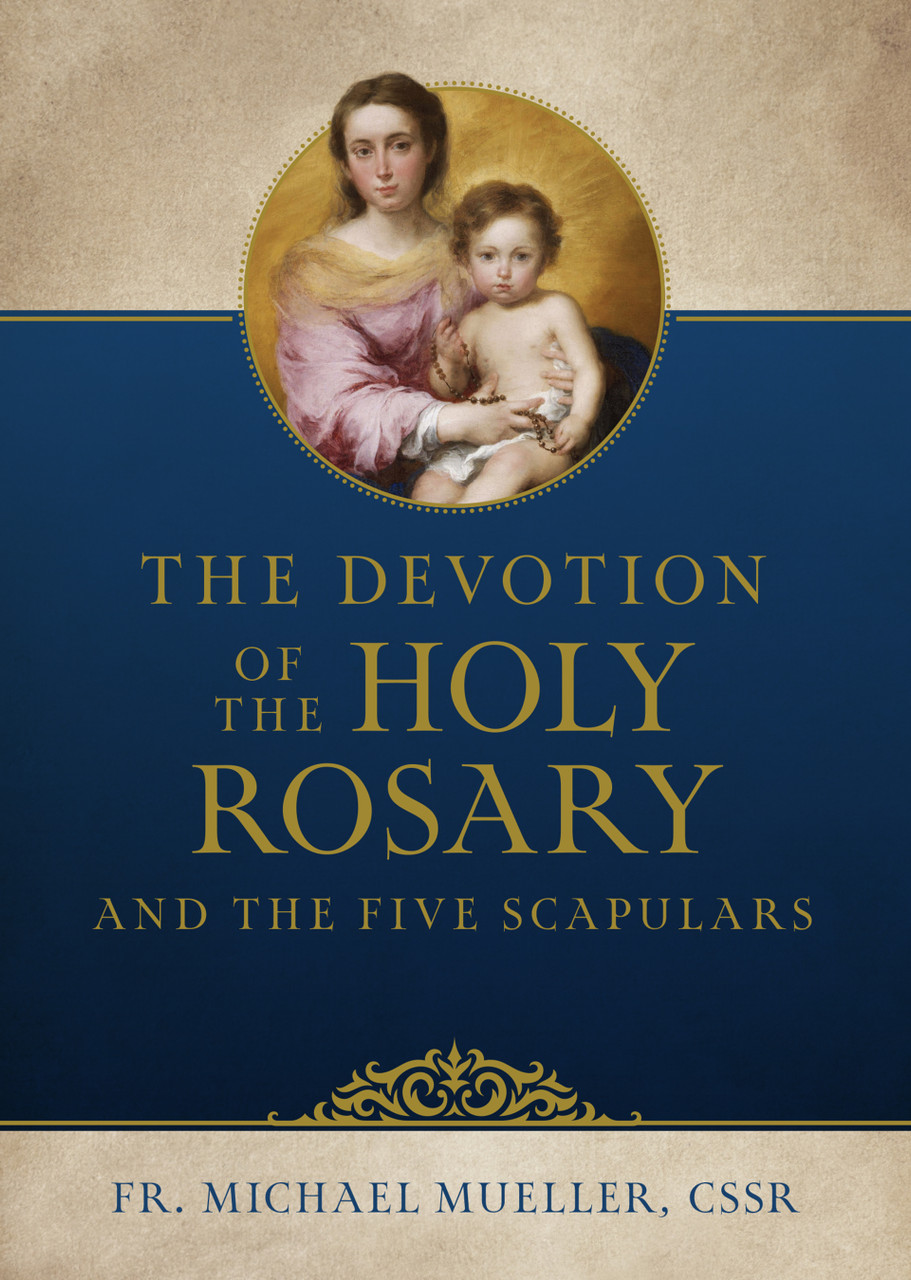
The Devotion of the Holy Rosary and the Five Scapulars
by Fr. Michael Mueller CSsR
Publisher
TAN Books
Published
May 30, 2026
ISBN
cp-the-devotion-of-the-holy-rosary-and-the-
Virtue scores
Review
SECTION ONE For centuries, Catholics carried their faith in their hands and on their bodies — beads worn smooth by daily prayer, a small brown cloth sewn into a garment worn against the skin. This TAN Books edition gathers instruction on two of the most durable of those material devotions: the Holy Rosary and the five Scapulars of the Carmelite, Dominican, Servite, Trinitarian, and Augustinian traditions. The book answers a practical question that many committed Catholics still ask: not whether these devotions matter, but how to practice them with the attention and fidelity they were designed to form. It explains the origins of each Scapular, the conditions for enrollment, the prayers proper to each, and the Rosary's meditative structure across its mysteries. The intended reader is not a scholar but a practicing Catholic who wants a reliable guide to what these devotions actually require — and what the Church has historically promised those who maintain them. The anonymous authorship suits the genre: this is a handbook, not a memoir, and TAN's tradition of reprinting such texts keeps it in print precisely because the demand has never disappeared. SECTION TWO - **Created**: The Rosary and Scapulars both assume that the body participates in prayer rather than hindering it. Beads counted on the fingers, cloth worn against skin, kneeling for decades — these are not accommodations to human weakness but expressions of the Catholic conviction that the whole person, body and soul together, is made to worship. The book's detailed physical instructions for wearing each Scapular treat corporeality as spiritually serious, not incidental. - **Fallen**: Both devotions were historically commended partly as remedies for the disordered will's tendency to forget. The Rosary's repetitive structure is a deliberate counter to distraction; the Scapular worn daily is a material memento that addresses the fallen person's propensity to live as though God were absent. The book tacitly acknowledges that sustained attention in prayer is not natural but must be trained against the grain of concupiscence. - **Redeemed**: The Rosary's Glorious Mysteries — Resurrection, Ascension, Pentecost, Assumption, Coronation — are not added as an afterthought but as the telos toward which the Joyful and Sorrowful Mysteries point. To pray the full Rosary is to rehearse the entire arc of redemption, placing one's own suffering and joy within the pattern of Christ's. The Scapulars similarly point to final perseverance as the horizon of daily fidelity, making eschatological hope a practice rather than a sentiment. - **Justice (devotion)**: The Scapular's enrollment conditions — living state of grace, wearing the cloth, reciting the prescribed prayers — are a structured form of what Aquinas calls the virtue of religion: the just rendering to God of what is owed. The book trains this virtue not by emotional appeal but by specifying the acts themselves, which is precisely how habit is built. - **Prudence (memory)**: The Rosary's fifteen (or twenty, with the Luminous Mysteries) meditative scenes function as a structured exercise in prudential memory — the integral virtue by which the soul retains the truths of salvation history and draws on them in present decision-making. Regular practitioners report that the mysteries become a mental library they access in difficulty, which is exactly the Thomistic account of memoria as a component of practical wisdom. SECTION THREE Pope Francis, in Dilexit nos[^1], traces how exterior devotional practices — including those associated with the Sacred Heart — are meant to draw the person into an encounter with Christ's interior life rather than remain at the surface of observance; this book's insistence that the Scapular must be worn with genuine intention, not mere custom, maps onto the same concern. Teresa of Avila[^2], in the Way of Perfection, argues that detachment, humility, and fraternal love together prepare the soul for genuine prayer — a formation program that the Rosary's meditative structure quietly enacts by moving the practitioner weekly through the mysteries of Christ's humility, suffering, and glory. ## References 1. Pope Francis (2024). *Dilexit nos*. Vatican document. — 'Saint Margaret Mary Alacoque, Autobiography, n. 53 and n. 55' 2. Teresa of Avila (trans. Peers, 1934-35). *Way of Perfection*. Introduction and Chapters 4-15. — 'fraternal love, detachment and humility: these three virtues...will make the soul mistress and sovereign over all created'
✓ Strengths
- ✓The book treats Marian devotion and sacramental practice as genuinely ordered to the whole person — body included — rather than as purely interior sentiment, which coheres with the CCMMP premise that the human person is a unity of body and soul; the Rosary's physical beads and the Scapular's worn cloth are material forms through which spiritual formation occurs.
- ✓The five Scapulars give structured, externally maintained commitments that train the virtue of fidelity over time, operating as habituated dispositions in the Thomistic sense — repeated acts shaping character rather than one-off resolutions.
- ✓The Rosary's meditative mysteries — Joyful, Sorrowful, Glorious — move the person through the full arc of Christ's life, providing a built-in pedagogy of memory that roots the soul in salvation history rather than in abstract piety.
- ✓By directing the practitioner to offer prayers for the Church, for sinners, and for the souls in purgatory, both devotions cultivate the justice sub-virtue of sacrifice: the deliberate offering of one's time and attention as an act of worship that reaches beyond private benefit.
- ✓The text's practical instructions — how to wear, how to pray, what conditions must be met — embody prudence-teachability by placing the reader under the authority of a long tradition rather than encouraging self-constructed spiritual practice.
⚠ Considerations
- ⚠The devotional structure, if presented as a checklist of observances to be performed for guaranteed spiritual outcomes, risks nudging readers toward a transactional understanding of grace rather than the participatory, relational encounter that the CCMMP's Redeemed state requires.