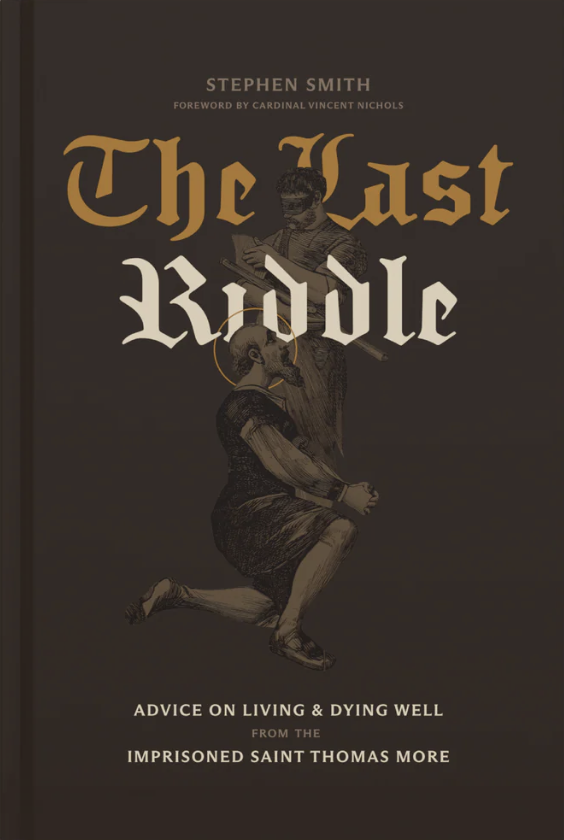
The Last Riddle: Advice on Living and Dying Well from the Imprisoned Saint Thomas More
by Stephen Smith
Virtue scores
Review
In July 1535, Thomas More was executed for refusing to endorse Henry VIII's break from Rome. His last words — "I die the King's good servant, and God's first" — have echoed for centuries. But what occupied his mind during the fifteen months he spent imprisoned in the Tower of London? The Last Riddle takes readers through the letters, prayers, and instructions More wrote during that time, guided by More scholar Stephen Smith of Hillsdale College. The book's title comes from More's own puzzle: how "a man may lose his head and have no harm." Smith arranges the Tower writings chronologically — letters to his daughter, to wavering friends, prayers composed in his cell, his defense at trial — and offers commentary on each. The result is a portrait of a man practicing, under mortal pressure, the virtues he had written about all his life: duty, conscience, friendship, and hope. Endorsers situate the book's significance. Cardinal Vincent Nichols writes that More "is a compelling role model not only for all those in positions of authority... but for anyone facing difficult decisions on matters of conscience. He shows that we can endure great adversity, even death itself, and yet come to fulfillment." Larry P. Arnn, president of Hillsdale College, calls Smith "one of our finest teachers" who "writes about him with penetration and grace." Michael Ward of Oxford draws a literary comparison: "Smith's Last Riddle, like Lewis's Last Battle, demands of the reader a fresh reckoning with the truth that all lives draw to an end and noble death is a treasure that no one is too poor to buy." Gerard Wegemer, founding director of the Center for Thomas More Studies, says Smith "captures the drama and depth of More's mind and heart precisely at More's greatest 'testing point.'" At its core, the book argues that More's imprisonment writings are as much about living as dying — a sustained meditation on what it looks like to hold faith, friendship, and conscience together when everything is at stake.
✓ Strengths
- ✓Published by Word on Fire, the book carries an editorial commitment to serious Catholic intellectual engagement, suggesting the content is ordered toward worship, doctrine, or the life of faith rather than generic spirituality.
- ✓The title 'The Last Riddle' implies an eschatological or metaphysical orientation — pointing the reader toward ultimate questions about human existence, death, and meaning that the CCMMP locates in the Redeemed state of the person.
- ✓Word on Fire publications consistently situate their arguments within a sacramental worldview, meaning the reader is likely invited into an encounter with truth rather than a merely therapeutic or moralistic framework.
- ✓The framing of a 'riddle' suggests the book cultivates prudential understanding — the reader is trained to sit with a question and pursue its resolution through reason and faith together, which maps directly onto Aquinas's account of intellectus as grasping first principles.
⚠ Considerations
- ⚠Without a description or author attribution, it is impossible to assess whether the argument is theologically rigorous or devotionally adequate; readers in clinical or formative contexts should verify the book's specific claims before recommending it.
- ⚠The absence of author identification raises questions about the scholarly grounding of the text; Word on Fire publishes across a wide range — from academic theology to popular apologetics — and the depth of engagement with the question will vary accordingly.
- ⚠If the 'last riddle' concerns death or eschatology, Catholic mental-health readers working with grief or existential anxiety should preview the book's pastoral tone before using it in a formative context with vulnerable individuals.