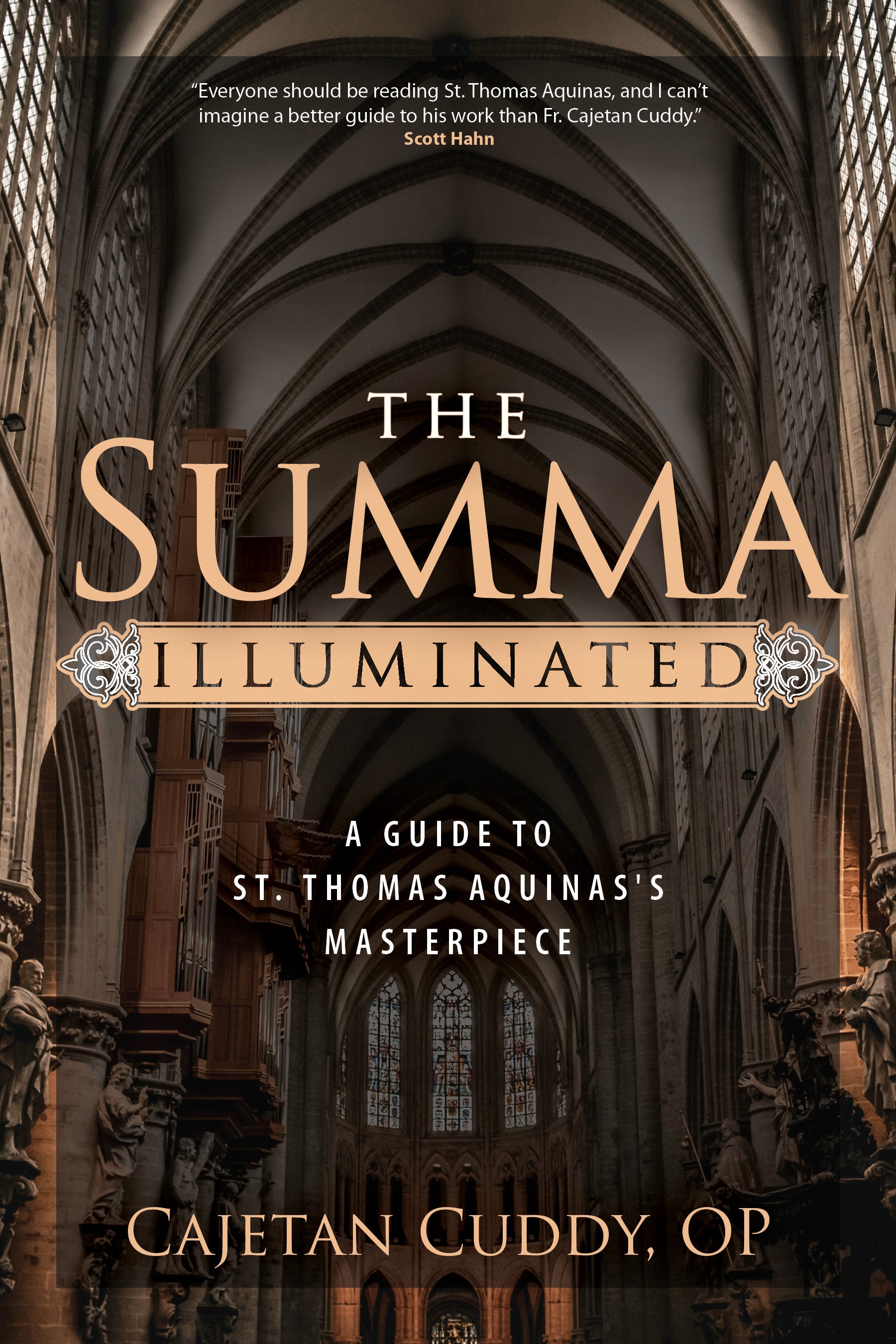
The Summa Illuminated: A Guide to St. Thomas Aquinas's Masterpiece
by Cajetan Cuddy, OP
Virtue scores
Review
There is a particular kind of intellectual frustration that serious Catholic readers know well: the experience of picking up the Summa Theologica, reading a few pages, and setting it back down — humbled, confused, and vaguely guilty. The Summa is everywhere recommended and almost nowhere actually read. Fr. Cajetan Cuddy, a Dominican friar and premier Aquinas scholar, opens The Summa Illuminated by confessing that he was once that frustrated reader himself, a teenager perplexed by Aquinas's use of the word "accident" — which has nothing to do with dropping a glass vase. His solution is the book he then spent years wishing someone had written: a guided tour of the Summa Theologica that makes its architecture visible before the reader enters its corridors. Order is the organizing principle of both the Summa and of The Summa Illuminated — and it is the key to understanding why Cuddy's book works. Aquinas, he argues, was before all else a teacher, and the Summa Theologica was written not for specialists but for beginners in theology, students who already possessed philosophical formation but were novices in the study of divine things. This is a startling claim, given how forbidding the Summa feels to modern readers, and Cuddy addresses the paradox directly: the problem is not that the Summa is unsuited for beginners, but that we come to it without the philosophical preparation Aquinas assumed. His book restores that preparation, supplying — in plain language and with genuine pastoral attentiveness — the conceptual vocabulary Aquinas presupposed. The governing metaphor of the introduction is one of the finest things in the book: Cuddy compares the Summa to a medieval cathedral. Like a cathedral, it is both simple and complex — simple because it has one resounding message ("God is real"), complex because it comprises a multitude of carefully ordered parts that together communicate that message. Every arch and nave of a cathedral has a purpose; nothing is random. The same is true of Aquinas. And just as a guided tour of a cathedral illuminates what overwhelmed observation might miss, Cuddy's book shows readers how each part of the Summa — the three parts covering God and Creation, the Human Person's Movement to God, and Jesus Christ and the Sacraments — contributes to a unified theological vision. Crucially, Cuddy insists that this vision is not merely intellectual but transformative. Aquinas, he writes, "is not interested in cultivating a class of smart people." The Summa is ordered to salvation — to the complete transformation of the reader in Jesus Christ. Sacred doctrine is not an academic exercise; it is a spiritual discipline, the content of which is the God who reveals himself out of love so that human persons, fitted by philosophy and elevated by grace, can actually know and love him. This distinction between information and formation runs throughout Cuddy's commentary, and it saves the book from becoming a mere intellectual outline. The structure of The Summa Illuminated follows the Summa itself, walking readers through each of its three parts while explaining the logical necessity of the sequence. Aquinas does not begin with Christ because, Cuddy shows, you cannot understand the redemption without first understanding what was created and why it is in need of redemption. The book's pedagogical payoff is considerable: by the end, readers possess not just a map of the Summa but a felt sense of why the map is shaped the way it is. One limitation worth noting is that The Summa Illuminated is genuinely preparatory — it is a guide to reading Aquinas, not a replacement for doing so. Readers who want to be carried through the Summa's actual arguments will need to take the next step themselves. But that is precisely Cuddy's point, stated plainly in his introduction: this book succeeds when it makes you want to read Aquinas, not when it lets you avoid him. A single reader review captures the experience well: "After reading Fr. Cuddy's book, you may find yourself ordering the complete set of the Angelic Doctor's ST." For anyone who has felt the pull of the Catholic intellectual tradition but found the Summa's threshold too high, The Summa Illuminated is the door Aquinas always intended to be open. Sources: The Summa Illuminated — Ave Maria Press The Summa Illuminated Sample PDF — Ave Maria Press
✓ Strengths
- ✓Engages the Summa Theologiae as a living text rather than a museum artifact, making Aquinas's arguments about the human person accessible to readers without prior philosophical training.
- ✓Situates Thomistic reasoning within a recognizably Catholic anthropology, affirming the unity of intellect, will, and appetite that Aquinas develops across the Prima Pars and Prima Secundae.
- ✓Published by Ave Maria Press, a historically reliable Catholic imprint, suggesting editorial formation consistent with orthodox Catholic intellectual tradition.
- ✓Addresses the virtue architecture of the Summa — prudence, justice, fortitude, temperance — in a manner that could serve formators, counselors, and lay readers seeking a structured moral framework.
- ✓The title's 'illuminated' framing suggests an approach attentive to the contemplative and aesthetic dimensions of Scholastic theology, not merely its logical skeleton.