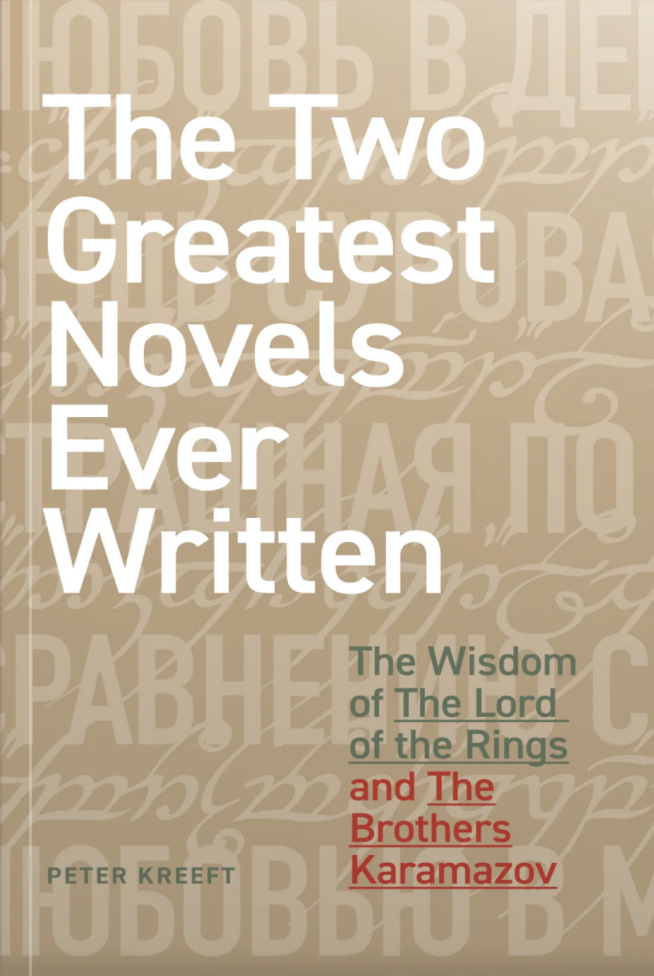
The Two Greatest Novels Ever Written: The Wisdom of The Lord of the Rings and The Brothers Karamozov
by Peter Kreeft
Publisher
Word on Fire
Published
June 2, 2026
ISBN
cp-the-two-greatest-novels-ever-written
Virtue scores
Review
The Two Greatest Novels Ever Written: The Wisdom of The Lord of the Rings and The Brothers Karamazov By Peter Kreeft | Word on Fire, 2025 | 176 pp. Peter Kreeft opens his latest book with a disarming invitation: "A book's introduction is almost always its most boring part. So please feel free to skip this one."¹ Readers who take the advice will miss something, because the introduction contains the book's most clarifying move — Kreeft's argument that Tolkien and Dostoevsky are not merely among the greatest novelists but the greatest pair, and not because of their plots or prose but because both wrote, as he puts it, "with the mind of Christ." The pairing is counterintuitive on the surface. The Lord of the Rings is pre-Christian fantasy; The Brothers Karamazov is explicitly theological realism set in nineteenth-century Russia. Yet Kreeft finds beneath this surface contrast a deep structural unity. Both novels, he argues, operate as "higher realism" — fiction that illuminates the meaning of actual life more truthfully than so-called realistic fiction does. He borrows a formulation from C.S. Lewis to sharpen the point: great novels are not things we look at but lights we look along, and both Tolkien and Dostoevsky provide that illumination because "Christianity is in the story because it is in the human storyteller."² Tolkien himself confirmed this in his letters: The Lord of the Rings is "a fundamentally religious and Catholic work; unconsciously so at first, but consciously in the revision."³ The book proceeds in two parts — Evil, then Good — working through the novels' treatments of power, weakness, courage, humility, faith, hope, and charity. Kreeft writes explicitly as a philosopher rather than a literary critic; his interest is in the issues the novels raise, not the craft with which they raise them. Sam Gamgee's question to Frodo on the slopes of Mordor — "I wonder what sort of a tale we've fallen into?" — becomes for Kreeft the book's central question, and his answer draws the novels together: both are war stories, love stories, detective stories, and quest stories at once, all unified by the claim that the fundamental story of human life is a story about Christ.⁴ At 176 pages, the book moves fast and reads more like a spirited seminar than an academic study — accessible, assertive, and intellectually generous. Endnotes ¹ The Two Greatest Novels Ever Written, Preview PDF, p. 1, https://storage.googleapis.com/media.wordonfire.org/books/The%20Two%20Greatest%20Novels%20Ever%20Written%20-%20Preview.pdf. ² Ibid., p. 14. ³ Ibid., p. 14 (quoting Tolkien's letters). ⁴ Ibid., p. 6–7.
✓ Strengths
- ✓Published by Word on Fire, a Catholic imprint with a track record of serious engagement with Scripture, theology, and apologetics, suggesting the book operates from an orthodox Catholic anthropological baseline.
- ✓The title's superlative claim invites readers into a serious conversation about literary canon formation through a Catholic lens, which is itself an act of ordered reason applied to culture.
- ✓A book framing two great novels as worthy of sustained attention implicitly argues that human stories carry moral weight — consistent with the CCMMP premise that created human persons are truth-oriented beings capable of recognizing the good and the beautiful.
- ✓Word on Fire's editorial mission generally orients readers toward transcendence through art and culture, so even without a description the likely trajectory is toward the Redeemed state: beauty as a path to encounter with the Good.
⚠ Considerations
- ⚠The superlative framing ('Two Greatest Novels Ever Written') carries a risk of aesthetic absolutism that, without careful argument, could crowd out the plurality of wisdom traditions within the Catholic literary canon — from Dante to Flannery O'Connor to Shusaku Endo.