Virtue scores
Review
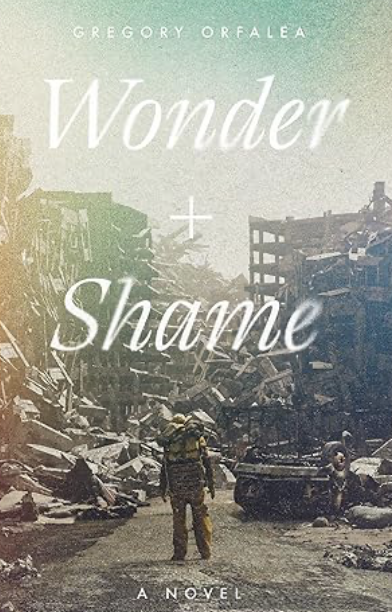
Gregory Orfalea's debut novel *Wonder + Shame* arrives as one of the more ambitious works of Catholic fiction in recent memory — a 448-page pilgrim's journey that draws its architecture from Dante, its moral seriousness from Hemingway, and its surprising emotional center from baseball. Published by Bishop Robert Barron's Word on Fire Luminor imprint, the novel follows Frank Matter, a sixty-year-old Syrian-American historian living in Los Angeles who, in the spring of 2016 and battered by personal grief, boards a one-way flight to Damascus on what he himself half-suspects is a death wish. What he finds instead is a reason to live. ## Plot and Structure The novel is organized in three movements that map deliberately onto Dante's *Commedia*: Part I (*Inferno*), Part II (*Purgatory*), and Part III (*Home* — tellingly, not Paradise, but something humbler and more hard-won). This structural choice signals Orfalea's intentions clearly. *Wonder + Shame* is not a war novel that happens to have a spiritual dimension; it is a spiritual novel that uses war as its crucible. Frank's journey begins in sorrow. His backstory — a father and sister who died in a murder-suicide, a failed professional life, a faith worn down to a single reluctant thread — is established in Chapter 1 with the quiet, accumulative intimacy of someone who has lived long enough to know that grief does not announce itself. He boards the plane, crosses himself furtively, and we understand immediately that the novel's real subject is not Syria but Frank's interior. The opening pages move between the plane and a memory of his ailing mother Mary-Rose in the house where Candy died, and Orfalea navigates these registers with accomplished ease — the prose is warm, unhurried, and alive to sensory detail. In Syria, Frank's twin missions — rescuing his deaf cousin Dayzi, known as the Seamstress of Damascus, and teaching a group of traumatized refugee orphans to play baseball — converge in the sprawling refugee camp of Urfa, on the Turkish-Syrian border, where they are stranded by the ongoing civil war. The refugee camp functions as the novel's Purgatorio: a liminal space where nothing is resolved, where the rules of ordinary life no longer apply, and where purification happens through suffering and solidarity rather than through heroics. The novel's prologue is narrated by Majid, a seventeen-year-old refugee boy who lost his entire family to a barrel bomb. His voice — wise, slightly formal, touched with the compression of someone who learned English as a survival skill — frames the story retrospectively and lends it a mythic distance that Orfalea uses to good effect. The table of contents reads almost like a poem in itself: "Dust," "The Three Children," "The Mosque at Urfa," "Girl in Burka at Hot Corner," "She Is Gawn!" — chapter titles that suggest the novel's tonal range, from tragedy to tragicomedy to something approaching grace. ## Themes and Literary Achievement Orfalea's central wager is that baseball — with its formal insistence on fair play, its indifference to the clock, and its refusal to end until the last out is made — is an unlikely but coherent metaphor for hope in a place where hope has been systematically destroyed. The novel's epigraph from Roger Angell ("Since baseball is measured only in outs, all you have to do is succeed utterly: keep hitting, keep the rally alive, and you have defeated time") carries more thematic freight than it might first appear. For the orphans of Urfa, who have been robbed of childhood, baseball offers — absurdly, stubbornly — the possibility of a game that is never definitively over. Against this, Orfalea places a frank confrontation with violence, moral ambiguity, and the failure of international institutions to intervene in Syria's catastrophe. The novel's 2016 setting is not incidental: the presidential campaign runs as a grim counterpoint to Frank's journey, and the novel positions political cynicism and the erosion of truth as the domestic mirror of Syria's devastation. The Hemingway epigraph — Anselmo's meditation on the need for penance after the killing — establishes this moral reckoning as the novel's real spine. The prose is the work of a poet (Orfalea has published verse throughout his career) with a historian's instinct for the telling detail. At its best, it achieves the quality Orfalea himself names in his epigraph from Fr. Joseph Schwab, OFM: "Love, then understanding." The novel earns its emotional payoffs by refusing sentimentality in the early going, so that when grace arrives — and it does arrive — it feels neither cheap nor coerced. If the novel has weaknesses, they lie in its length and occasionally in its sprawl. At 448 pages, the Purgatorio section in particular risks losing momentum as the camp chapters multiply. Some of the secondary characters — the Swedish aid worker Greta Johanssing, the various orphan players — are vivid in isolation but compete for attention in ways the narrative does not always resolve. And the novel's satirical treatment of American politics, while pointed, occasionally pulls the reader out of the more fully inhabited world of the camp. These are minor complaints against a book of genuine ambition and considerable achievement. The blurbs from Alice McDermott (National Book Award-winning author of *Charming Billy* and *The Ninth Hour*) and Michael Murphy (Director of the Hank Center for the Catholic Intellectual Heritage at Loyola) are not honorary — they reflect the quality of what Orfalea has accomplished here. ## Conclusion *Wonder + Shame* is a novel about what it costs to remain human when the world is doing its best to make humanity impossible. Orfalea writes from inside the Catholic intellectual tradition — with Dante's structural ambition, a Franciscan's tenderness, and a Syrian-American's personal stake in the subject — and produces a work that is both timely and durable. It is the rare debut novel that feels like the culmination of a life's work rather than a beginning. *Review written June 2026. Primary sources: Word on Fire Luminor product page and publisher preview (chapters 1–4).*
✓ Strengths
- ✓Holds together two affective states — wonder and shame — that are typically treated as opposites, allowing the book to address the full range of human emotional experience before God without flattening either pole.
- ✓Published by Word on Fire, the book operates within an explicitly Catholic theological register, making it accessible to readers who want their emotional and spiritual lives addressed within a coherent doctrinal framework rather than as parallel tracks.
- ✓The pairing of wonder and shame maps naturally onto the Created-Fallen arc: wonder as the felt recognition of original goodness and the imago Dei, shame as the affective residue of the Fall and disordered desire — giving readers a concrete anthropological vocabulary for interior experience.
- ✓By treating shame as a spiritual and anthropological category rather than purely a psychological one, the book complements clinical approaches to shame-based suffering with a theological account of restoration, pointing toward redemption without bypassing the wound.
- ✓The Word on Fire imprint signals engagement with contemporary intellectual culture, suggesting the book is written for readers who live at the intersection of faith and daily secular life rather than for a purely monastic or devotional audience.
⚠ Considerations
- ⚠The female lead, Dayzi, is described as escaping from "predator-clients on both sides of the war." This strongly implies sex trafficking or prostitution as a plot element.
- ⚠War violence: The Syrian civil war, chemical weapons attacks, and refugee camp conditions are central to the story. Likely to be visceral, though literary.
- ⚠Explicit family trauma: murder-suicide. The novel's backstory involves Frank's sister Candy killing herself and their father. While treated with literary care and psychological realism rather than sensationalism, this content is present and emotionally demanding. Readers with personal experience of suicide or family violence should be forewarned.