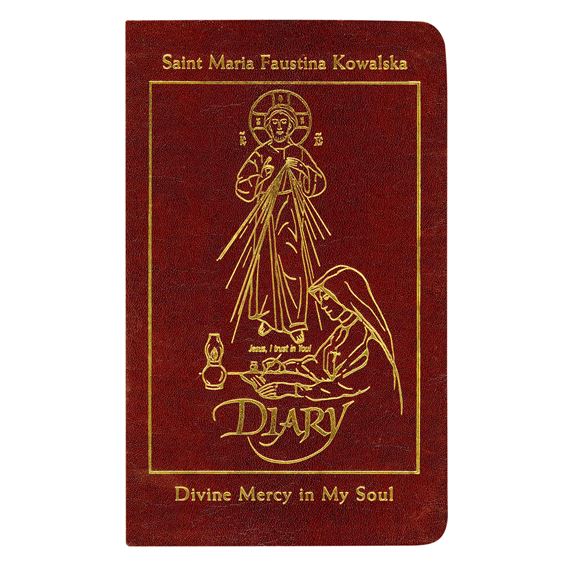
DIARY OF ST. FAUSTINA - BURGUNDY LEATHER EDITION
by Saint Maria Faustina Kowalska
Publisher
EWTN Religious Catalogue
Published
July 2, 2026
ISBN
cp-diary-of-st.-faustina---burgundy-leather
Virtue scores
Review
St. Maria Faustina Kowalska was a Polish nun of no formal education and no public platform when, between 1934 and 1938, she filled a series of notebooks at her confessor's instruction. Those notebooks became the Diary: Divine Mercy in My Soul, one of the most widely read works of Catholic mystical literature in the twentieth century. The Diary is not a systematic theology. It is a record — candid, sometimes startling, occasionally repetitive — of what Faustina believed Christ said to her in prayer, set alongside her own confessions of weakness, her descriptions of convent life, and her growing sense of a mission she neither sought nor fully understood: to spread a message of God's mercy to a world she sensed was approaching catastrophe. The EWTN burgundy leather edition is a devotional-grade production intended for sustained personal use — daily reading, prayer, retreat. Its audience is anyone who has encountered the Divine Mercy devotion through the Chaplet or the Image and wants to go back to the source. That source turns out to be considerably more interior, more demanding, and more theologically serious than the devotion's popular reception sometimes suggests. - **Created**: The Diary grounds human dignity not in achievement but in the sheer fact of being addressed by God. Christ's repeated insistence — across hundreds of entries — that every soul is of infinite worth to him is not sentimental reassurance; it is a claim about what the person is at the level of being. This is the imago Dei named not in abstract doctrine but in the concrete grammar of divine speech directed at a single woman in a Polish convent. - **Fallen**: Faustina does not soft-pedal the disorder of the human will. Her own entries record envy, pride, failures of charity toward her sisters, and the exhausting pull of self-concern. These are not dramatized for effect; they are confessed with the plainness of someone who has been taught to examine conscience seriously. The Diary's account of the Fallen state is precise where generic treatments are vague: she names specific disordered appetites and traces how they resist grace even in a soul that genuinely wants to cooperate. - **Redeemed**: The theological center of the Diary is the claim that mercy is not a concession to human weakness but the primary mode of God's engagement with the Fallen person. Faustina's record of confession — frequent, detailed, submitted to her director — models the sacramental mechanism of Redemption rather than leaving it at the level of aspiration. Grace here is not a mood but a transaction with structure: contrition, absolution, renewed resolve. - **Justice (adoration)**: The devotional practices the Diary generated — the three o'clock Hour of Mercy, the Chaplet prayed at the bedside of the dying, the veneration of the Image — are not decorative additions to Faustina's interior life. They are her way of giving God what is owed: the proper return of love for love. In Thomistic vocabulary, this is the virtue by which the soul renders fitting worship to God, treated under the virtue of justice in the Summa Theologiae at II-II, q. 81.[^3] - **Prudence (docility)**: What protects the Diary from the category of mere spiritual enthusiasm is Faustina's consistent submission to her confessor's judgment. When directors told her to wait, she waited. When they told her to write, she wrote. This is docility in the sense Aquinas develops as one of prudence's integral parts, addressed at II-II, q. 49 — not passivity, but the wise recognition that one's own perception of divine inspiration requires external confirmation.[^4] The Diary sits in natural conversation with two works. Therese of Lisieux's account in Story of a Soul of her own 'dark tunnel'[^1] — the months-long trial of faith in which the thought of Heaven became 'a subject of conflict and torture' rather than consolation — illuminates Faustina's parallel passages on desolation and spiritual darkness. Both women locate the trial not as evidence of divine abandonment but as a purification that strips the soul of consolation-dependent faith. Pope Francis's 2024 encyclical Dilexit nos, which draws directly on the Dicastery for the Doctrine of the Faith's 2024 norms for discerning alleged supernatural phenomena,[^2] provides the contemporary magisterial frame within which the Diary's private revelations should be read: authoritative in their ecclesially approved devotional fruit, not binding as doctrinal propositions.
✓ Strengths
- ✓The Diary gives one of the most sustained first-person accounts in Catholic literature of the soul in direct conversation with God, making it a primary source for the virtue of prayer understood as genuine communication rather than formalized petition.
- ✓Faustina's record of her interior sufferings, consolations, and visions models the docility Aquinas identifies as an integral part of prudence (Summa Theologiae II-II, q. 49): she submits each locution to her confessor and spiritual director, refusing to act on private revelation without ecclesial confirmation.
- ✓The devotion to Divine Mercy that the Diary generated — the Chaplet, the Image, the Feast — offers readers concrete liturgical and devotional practices, connecting personal interior life to communal worship in a way that resists purely individualistic spirituality.
- ✓Faustina's repeated encounters with her own unworthiness alongside Christ's insistence on mercy provide a theologically precise account of the Fallen state: the soul is genuinely disordered, yet the disorder is met not with condemnation but with an offer of trust.
- ✓The Diary's emphasis on suffering accepted in union with Christ's Passion gives the virtue of sacrifice a personal and affective grounding that moves it beyond mere moral duty into what the tradition calls co-redemptive participation.
⚠ Considerations
- ⚠Readers new to private revelation literature may struggle with the Diary's genre: it mixes mystical locutions, prophetic warnings, and daily convent life without editorial apparatus distinguishing levels of theological authority. A brief preface or study guide is advisable for group or clinical use.
- ⚠Some passages include severe penitential language and imagery of divine judgment that, without proper spiritual accompaniment, could be misread by scrupulous readers as confirmation of excessive guilt rather than as an invitation to mercy.