Virtue scores
Review
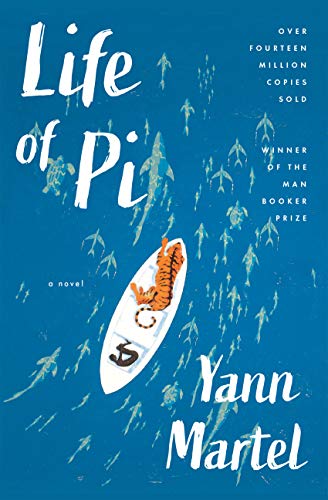
SECTION ONE A sixteen-year-old boy named Piscine Molitor Patel — Pi — survives 227 days on a lifeboat in the Pacific Ocean after a cargo ship sinks, accompanied by a 450-pound Bengal tiger named Richard Parker. That premise alone would make for a gripping adventure story. What Yann Martel built around it is something stranger and more demanding: a novel-length argument that the stories we tell about suffering are not decorations over bare fact but the very substance of how human beings endure. Pi is the son of a zookeeper in Pondicherry, a boy who has adopted Hinduism, Christianity, and Islam with equal sincerity, and who finds in each a different grammar for addressing the same overwhelming reality. The book's real question surfaces near its end, when Pi offers an investigator two accounts of the same ordeal — one populated by animals, one by human beings in extremity — and asks which version the investigator prefers. Martel's intended audience is anyone who has wondered whether religious belief is something that happens to a person or something a person chooses in full knowledge of the alternatives. Readers drawn to philosophical fiction, survival narrative, or theology-adjacent storytelling will find the novel absorbing and, at moments, genuinely disorienting. SECTION TWO - **Created**: The novel insists, through 227 days of bodily extremity, that Pi's dignity as a person is not a social construction contingent on civilization. Stripped of family, language, community, and most food, he continues to pray, to name his companion, to keep a journal, and to assert meaning over chaos. The CCMMP locates this irreducible orientation toward the good precisely in the person's constitution as imago Dei — not in circumstances but in being itself. - **Fallen**: The lifeboat is a theater of disordered appetite and violence. Pi must kill to eat; he witnesses predation at close range; the alternate version of the story implies acts he cannot narrate directly. Martel does not sentimentalize this. The Fallen condition in the CCMMP involves not merely moral weakness but the disordering of the passions when the will is deprived of its proper goods — exactly what the lifeboat systematically removes from Pi, one by one. - **Redeemed**: Pi's survival is not merely physical. He emerges from the ordeal capable of gratitude, narrative coherence, and continued religious practice. The CCMMP understands redemption not as the erasure of suffering but as its integration — the purgative stage in which deprivation, properly borne, becomes the condition for a deeper ordering of the soul. Pi's recurring acts of prayer in the worst moments of the voyage dramatize this mechanism rather than merely asserting it. - **Prudence (circumspection and caution)**: The novel's middle hundred pages function almost as a manual in practical wisdom under constraint. Pi reads survival literature salvaged from the lifeboat's locker, systematically assesses his resources, and develops a behavioral protocol for coexisting with a tiger. Aquinas treats caution and circumspection as integral parts of prudence because they attend to specific circumstances rather than abstract principles — and Pi's survival depends on exactly this kind of granular, situation-by-situation reasoning. - **Justice (devotion and gratitude)**: Pi's continued prayer — to Vishnu, Christ, and Allah — aboard the lifeboat is not theological confusion. It is the enactment of the virtue of devotion under conditions designed to extinguish it. His gratitude for rain, for a flying fish, for a calm night reads as spiritually literate rather than naive, the recognition that all goods are received rather than seized. SECTION THREE McKee[^1], in his account of the Quest structure, argues that every story turns on a protagonist whose life is thrown out of balance by an inciting incident and who then pursues the object that will restore it. Pi's inciting incident — the sinking of the Tsimtsum — is catastrophic rather than merely disruptive, and his object of desire is not a circumstance but a self: a self that can bear what he has seen and done and remain recognizably human. Peterson[^2], in Maps of Meaning, treats the unknown territory encountered by the protagonist as inherently dangerous and as processed through metaphor — the animal characters in Pi's story are precisely this kind of metaphorical processing, a way of making the intolerable cognitively manageable. Pierce[^3], drawing on the same Jungian tradition Peterson works within, observes that ideals and cherished hopes rise within a person only to meet 'the horrible truth and be shattered' — and that the response to that shattering divides people between determined optimism and bitter cynicism. Pi's choice, at the novel's end, to offer the animal story rather than the human one is Martel's argument that determined optimism is not delusion but a form of courage that the person in extremity owes to themselves. ## References 1. McKee, Robert (1997). *Story: Substance, Structure, Style and the Principles of Screenwriting*. — 'an event throws a character's life out of balance, arousing in him the desire for that which he feels will restore balance' 2. Peterson, Jordan B. (1999). *Maps of Meaning: The Architecture of Belief*. — 'this unexplored territory is dangerous... This form of information-processing is metaphor' 3. Pierce, Michael. *Motes and Beams: A Neo-Jungian Theory of Personality*. — 'ideals, dreams, and cherished hopes rise within us, only to meet the horrible truth and be shattered'
✓ Strengths
- ✓The novel places survival and meaning-making at its center, dramatizing how the human person — even stripped of every social support — retains a dignity that cannot be wholly undone by circumstance, a premise Vitz, Nordling, and Titus locate in the imago Dei as constitutive rather than conditional.
- ✓Pi's simultaneous practice of Hinduism, Christianity, and Islam is theologically problematic as a doctrinal claim, yet it functions narratively to insist that the human person is irreducibly oriented toward the transcendent — that the appetite for God is prior to any particular creed, which maps onto the CCMMP's premise of the person as naturally ordered toward ultimate ends.
- ✓The lifeboat ordeal is one of modern fiction's most sustained meditations on suffering as spiritually transformative rather than merely destructive; Pi's bodily extremity — starvation, thirst, solar exposure — forces an integration of body and soul under duress that the CCMMP treats as constitutive of growth in the purgative stage.
- ✓The novel's structural ambiguity — two versions of the same story, one with animals and one without — functions as an argument for the necessity of story itself in bearing unbearable truth, which connects to the CCMMP premise that the cogitative sense mediates raw experience into humanly livable form.
- ✓Pi's repeated acts of practical ingenuity aboard the lifeboat — rationing food, training Richard Parker, reading survival manuals — instantiate the virtue of prudence across nearly all its integral parts: circumspection, foresight, caution, and shrewdness working together under extreme constraint.
⚠ Considerations
- ⚠The novel's syncretism — Pi's cheerful simultaneous membership in three religions — is not merely a quirk but the book's explicit philosophical argument. Martel presents the religions as equally valid paths to the divine. This is incompatible with Catholic teaching on the uniqueness of Christ and the Church as the ordinary means of salvation, and formation readers should engage the text with that asymmetry in view.
- ⚠The novel's final appeal — 'which story do you prefer?' — positions religious belief as a pragmatic choice between more or less satisfying narratives rather than a response to revealed truth. This epistemological frame is attractive but ultimately instrumentalizes faith in a way that runs counter to the CCMMP's realist account of human knowing.