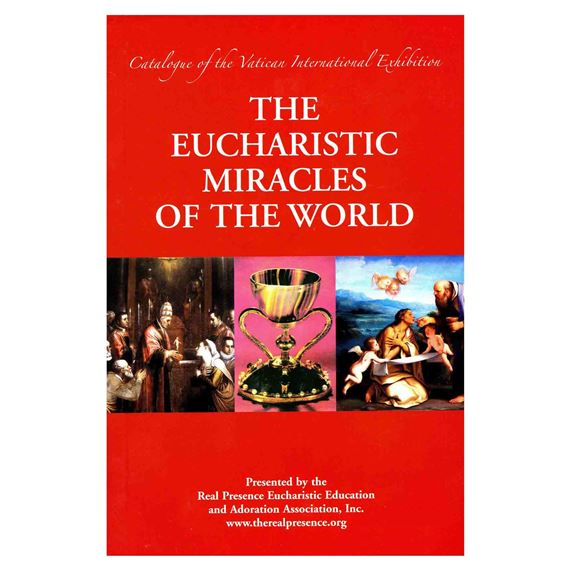
THE EUCHARISTIC MIRACLES OF THE WORLD
Publisher
EWTN Religious Catalogue
Published
June 17, 2026
ISBN
cp-the-eucharistic-miracles-of-the-world
Virtue scores
Review
SECTION ONE — Bookstore recommendation Somewhere in a small parish in Lanciano, Italy, around the eighth century, a priest who doubted the Real Presence reportedly witnessed the Eucharistic host transform into visible flesh and the wine into blood — and the tissue has been analyzed by modern pathologists as actual cardiac muscle. That account is one of dozens gathered in The Eucharistic Miracles of the World, published by EWTN Religious Catalogue as a companion to the Vatican's international exhibition of the same name. The book moves country by country through cases the Church has investigated: hosts that bled, that survived fire intact, that were found incorrupt after years in the ground. The intended audience is anyone whose Eucharistic faith has grown routine or who simply wants a documented record of the Church's own formal investigations into these events. It is less a work of theology than a well-organized archive — the kind of book a confirmation teacher, a parish priest preparing a Corpus Christi homily, or a skeptical inquirer would each find genuinely useful. SECTION TWO — Catholic anthropological reading - **Created**: The book affirms the material order as the proper medium of divine action. Each miracle occurs in bread and wine — physical, tangible substances — and the recurring pattern of bodily transformation testifies that matter is not incidental to grace. This is the imago Dei operating through the senses: God reaching human persons precisely through the body, not around it. - **Fallen**: The accounts repeatedly arise from moments of doubt, negligence, or outright disbelief. Priests who questioned the Real Presence, hosts that were stolen or desecrated — the miracles in this collection answer specific failures of faith and reverence. The Fallen condition appears not as abstract concupiscence but as the very occasion that occasions the sign. - **Redeemed**: The central movement of every account is restoration: doubt replaced by certainty, desecration answered by divine preservation, illness healed through Eucharistic intercession. The Redeemed state is not presented as a future hope but as a dateable historical event — a specific morning in a named city when something impossible happened and was witnessed. - **Justice (adoration)**: The book is, in its cumulative effect, a training in adoration. Aquinas located the virtue of religion — the proper rendering of worship to God — within justice, as giving God what is genuinely owed. Repeated encounter with these accounts conditions the reader to approach the altar not habitually but attentively, because the evidence before them is that the presence they receive is literal. - **Prudence (memory)**: The integral part of prudence that Aquinas calls memoria — learning from the past to govern present action — is exactly what this collection exercises. Reading accounts from eighth-century Italy, thirteenth-century Belgium, and twentieth-century Argentina trains the reader to hold the weight of a long tradition when they receive communion, rather than approaching the sacrament as if it were newly invented. SECTION THREE — Conversation with the canon A 1949 decree from the Sacra Congregatio Rituum[^1] formally declaring the reality of two miraculous healings — including the instantaneous recovery of a child from septicemia with bilateral bronchopneumonia and hemorrhagic nephritis — issued in Rome on the Third Sunday of Advent that year.[^2] That document exemplifies the formal ecclesiastical process this book presupposes: independent medical testimony, curial review, and a named prefect signing a dated decree. The Eucharistic Miracles of the World operates on the same logic, presenting cases that have passed through analogous scrutiny rather than circulating as unverified devotional reports. Chautard's The Soul of the Apostolate,[^3] argues that all external apostolic work is only as sound as the interior life that animates it — a claim that reads as a direct frame for this book's pastoral use: the Eucharistic evidence gathered here is ordered not toward apologetics alone but toward the interior renewal of the soul that must precede any fruitful action in the world. ## References [^1]: Sacra Congregatio Rituum. (1950). Decree on miraculous healings: Sanatione Sabatini Albano and Adelantado. *Acta Apostolicae Sedis*, 42, 207. "Constare de duobus propositis miraculis, videlicet de instantanea perfectaque sanatione." [^2]: Sacra Congregatio Rituum. (1950). Decree on miraculous healings: Sanatione Sabatini Albano and Adelantado. *Acta Apostolicae Sedis*, 42, 207. "Datum Romae, die 11 Decembris 1949, Dominica III Sacri Adventus." [^3]: Chautard, J.-B. (1946). *The soul of the apostolate*. Abbey of Gethsemani. [Nihil obstat and imprimatur edition, 1946.]
✓ Strengths
- ✓Documents cases approved through the Church's formal verification process, giving readers historically and ecclesiastically grounded accounts rather than devotional rumor.
- ✓Grounds Eucharistic faith in the bodily and material order — the transformation of bread and wine into flesh and blood — affirming the unity of body and soul central to Catholic anthropology.
- ✓Each miracle account implicitly narrates the arc from human need and petition through divine response, making the Redeemed state concrete and event-specific rather than abstract.
- ✓Cultivates the virtue of adoration by presenting the Eucharist not as a symbol to be interpreted but as a living presence confirmed by physical evidence, strengthening the disposition to worship.
- ✓Serves formators, catechists, and ordinary Catholics seeking to deepen or renew Eucharistic faith, particularly useful in the context of post-pandemic renewed interest in Eucharistic revival in the United States and beyond.
⚠ Considerations
- ⚠The collection format risks treating miracles as a catalog for apologetic deployment rather than as invitations to contemplative encounter; readers drawn primarily to the evidential argument may miss the formative dimension the accounts are meant to serve.